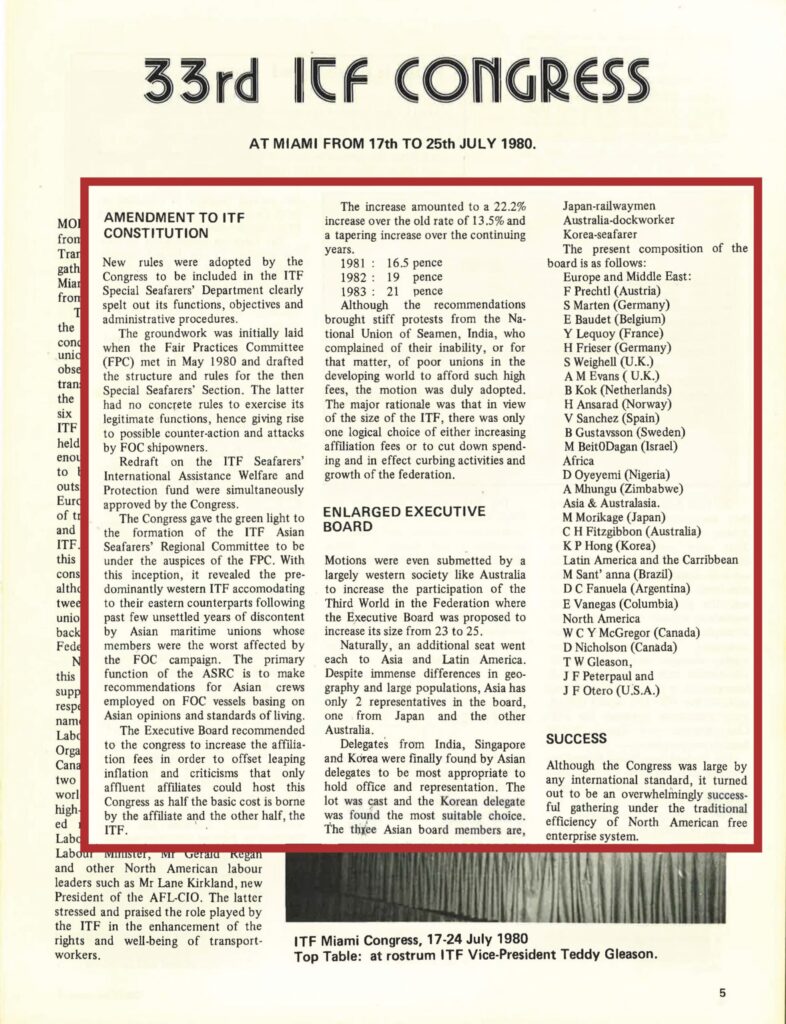
Three years later, at the 1983 ITF Fair Practices Committee in London, Singapore scored a win when Lim Boon Heng, then NTUC Assistant Secretary-General and SMOU advisor, was elected to the ITF Executive Board. This would massively amplify Singapore’s voice on the international platform.
Singapore then made the bold proposal to be removed from the list of FOC, citing the enactment of the Singapore Merchant Shipping Regulations 1981, which effectively changed the Singapore register from an open to closed register.
In one speech, Lim pointed out that Singapore’s new regulations have incorporated four of the seven recommended measures by the United Nations Conference on Trade and Development (UNCTAD), as it moved to raise ship registry standards.
As he put it:
“Singapore is no longer an open registry. UNCTAD has confirmed this. Singapore standards of safety are stringent, equal to the highest international standards. It is committed to training skilled seafarers. Singapore should now be known as a flag of quality and not a flag of convenience. We submit that it should now be removed from ITF’s list of flags of convenience.”
While this ruling marked a milestone, Singapore’s fight for its non-FOC status would continue for yet another seven years.
On the Offensive
At every ITF meeting, SMOU continued to press the case for Singapore. However, a more drastic action was needed.
Lim delivered a pointed commentary that made clear Singapore’s porcupine strategy—to defend itself by projecting power and tenacity. In this instance, the country was prepared to take the ITF to court in London.
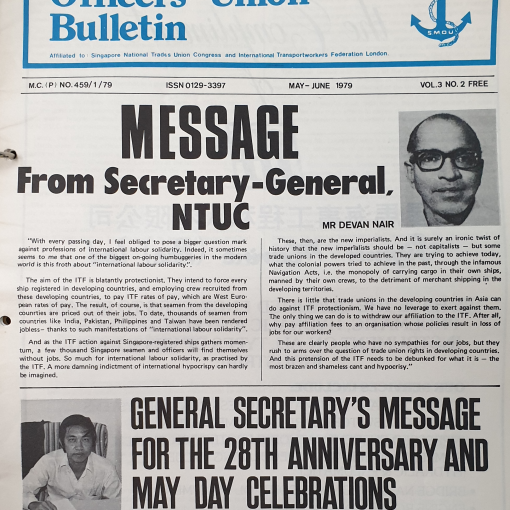
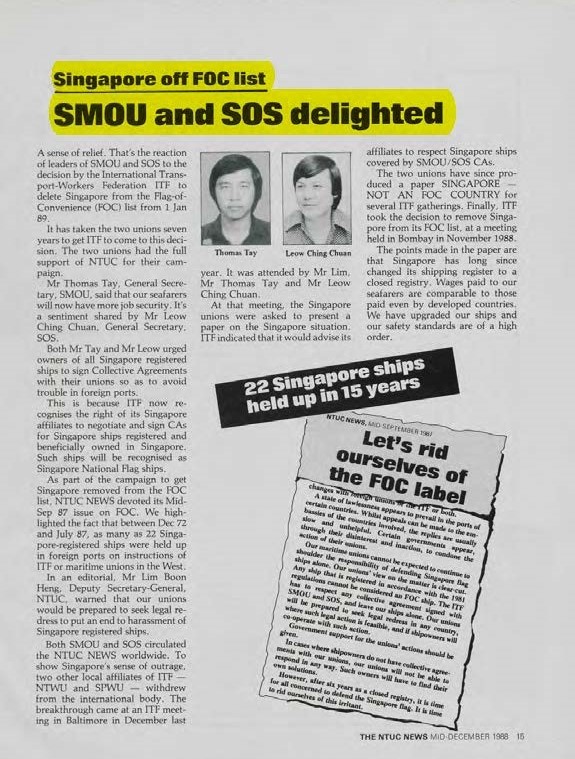
In a commentary, “Let’s rid ourselves of the FOC label,” which ran in a September 1987 issue of NTUC News, he wrote (extracts below):
“Six years after the Government changed the shipping register to a closed registry, Singapore flag ships are still being harassed by the International Transport Worker’s Federation (ITF) and its affiliates in a worldwide campaign against Flag-of-Convenience (FOC) ships.
In these six years, the battle against the ITF’s actions against Singapore flagships has been fought by our maritime unions (SMOU and the Singapore Organisation of Seamen)—almost always alone. No further progress is in sight so long as the ITF position is dictated by the views of Western unions.
Yet, by international standards, the Singapore registry is not a flag-of-convenience. UNCTAD (United Nations Conference on Trade and Development) considers the Singapore flag a closed registry. Not so the ITF. The ITF takes upon itself the role of judge and arbitrator in the matter.
Our maritime unions cannot be expected to continue to shoulder the responsibility of defending Singapore flagships alone. Our unions’ view on the matter is clear-cut. Any ship that is registered in accordance with the 1981 regulations cannot be considered a FOC ship. The ITF has to respect any collective agreement signed with SMOU and SOS and leave our ships alone. Our unions will be prepared to seek legal redress in any country where such legal action is feasible and if shipowners will cooperate with such action.”