Thank you for subscribing to Seavoices’ updates!

Please take a moment to check your email inbox and confirm your subscription to start receiving the latest news and updates.

04 May 2026
4 mins
May Day Rally 2026: Standing Together Through Stormy Waters

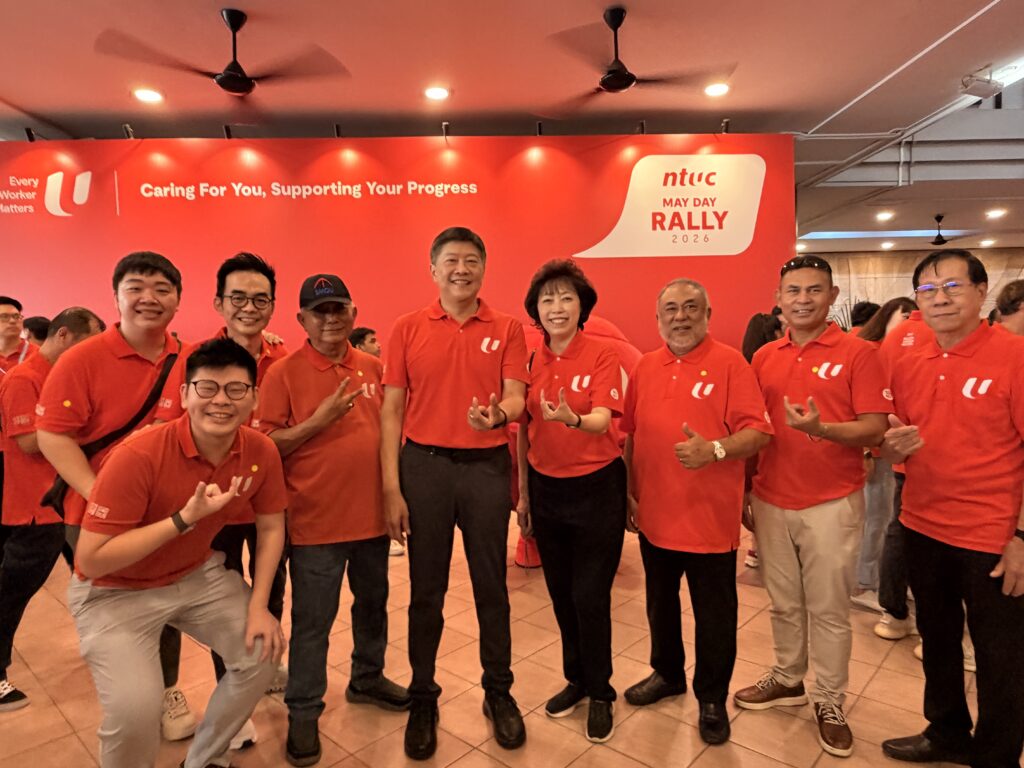
Held on 1 May 2026 at Downtown East, the May Day Rally brought together workers, union leaders, tripartite partners and the Government amid growing global uncertainty. With economic pressures mounting and rapid technological change reshaping work, the rally underscored a clear message. Singapore will move forward together, with workers firmly at the centre of every response.

NTUC Secretary-General Ng Chee Meng opened the rally by acknowledging the unease many workers are feeling today. Ongoing conflict in the Middle East, supply chain disruptions and global layoffs have created real anxiety across both blue-collar and white-collar roles. In Singapore, concerns around job security, retrenchments and changing career pathways are being felt most keenly by PMEs and young workers entering an increasingly uncertain labour market.

Photo Source: The Straits Time, Shintaro Tay

Despite these challenges, Brother Ng Chee Meng expressed confidence in Singapore’s tripartite system, built on decades of trust and partnership. He reminded workers that the labour movement has faced disruption before, from industrialisation to COVID-19, and emerged stronger each time by standing together.

2754a196-e653-45bf-aa18-abb18915bf83

Looking ahead, he outlined three commitments to guide the labour movement forward. First, a steadfast commitment to workers, including PMEs, younger workers and businesses that need support to transform. Second, building strong capabilities through skills upgrading, job redesign and productivity improvements. Third, collective action through tripartism, ensuring efforts by unions, employers and the Government are aligned and strengthened.

A key announcement was the formation of the Tripartite Jobs Council, which will bring these efforts together to support both workers and businesses through the AI transition. From young graduates seeking meaningful work to mid-career professionals navigating disruption, blue-collar workers looking to upskill and SMEs unsure where to begin, the council carries a clear commitment. No worker will walk alone.

Brother Ng Chee Meng also emphasised that care must remain at the core of the labour movement’s work. Care means providing practical support for workers facing cost-of-living pressures, career transitions and workplace change. It means ensuring progress is inclusive and that every worker matters. 

Photo Source: The Straits Time, Shintaro Tay

Prime Minister Lawrence Wong followed with a candid and sobering assessment of the challenges ahead. The closure of the Strait of Hormuz for more than two months, coupled with unresolved tensions in the Middle East, has disrupted global supply chains and driven up energy prices. He cautioned that even when the Strait reopens, recovery will take time due to damaged infrastructure and the need to restore confidence in shipping routes. 

For Singapore, a highly energy-dependent economy, the impact will be direct. Growth is expected to slow and inflation to rise, placing pressure on businesses, workers and households. Prime Minister Wong warned that stagflation risks are rising globally and that the current crisis could be as severe as, or worse than, the oil shocks of the 1970s. His message was not meant to alarm, but to ensure Singaporeans are mentally prepared for a more difficult period ahead.

At the same time, he emphasised that Singapore is not facing this crisis from a position of weakness. Decades of disciplined planning and investments in energy resilience have strengthened the nation’s ability to weather shocks. Today, Singapore is a key node in global energy flows, supported by diverse supply networks built through sustained collective effort.

At the heart of this resilience are workers. Prime Minister Wong paid tribute to those in refineries, power plants and the energy and chemical sectors who work round the clock to keep Singapore running. For maritime and energy-related workers, closely linked to shipping lanes and global trade flows, geopolitical tensions and supply disruptions are not abstract developments but daily realities.

Photo Source: The Straits Time, Shintaro Tay

Both leaders also spoke about artificial intelligence as a major force reshaping the economy. Describing AI as the defining technology of our time, Prime Minister Wong highlighted how rapidly jobs and industries are changing. While some roles will be disrupted, he assured workers that new and better opportunities will emerge, and that Singaporeans will not be left to navigate change alone.

As Singapore navigates stormy waters ahead, the May Day Rally 2026 reaffirmed what defines the labour movement. Resilience, partnership and solidarity. With strong tripartism and a shared commitment to care for one another, Singapore’s workers can face uncertainty not in isolation, but together.